Did you know that 2025 is the European Year of Digital Citizenship? This year, the Council of Europe is highlighting the importance of digital citizenship education. The aim is to promote an inclusive digital culture and prepare citizens to navigate a world where digital technology is becoming increasingly important.
Digital citizenship refers to the responsible, ethical and safe use of digital technologies by individuals. It encompasses the ability to navigate safely in the online environment, understand the ethical and social implications of digital technologies, and participate actively in the digital society in an informed and critical manner. Digital citizenship aims to promote inclusion, equity and respect for human rights in the digital world.
In October, we will release of the Erasmus+ DigiCity project games, including a video game and an escape game, which aim to develop the digital citizenship skills of young people aged 16 to 25. In the meantime, we share 3 video games that will make you think about different aspects of digital citizenship!
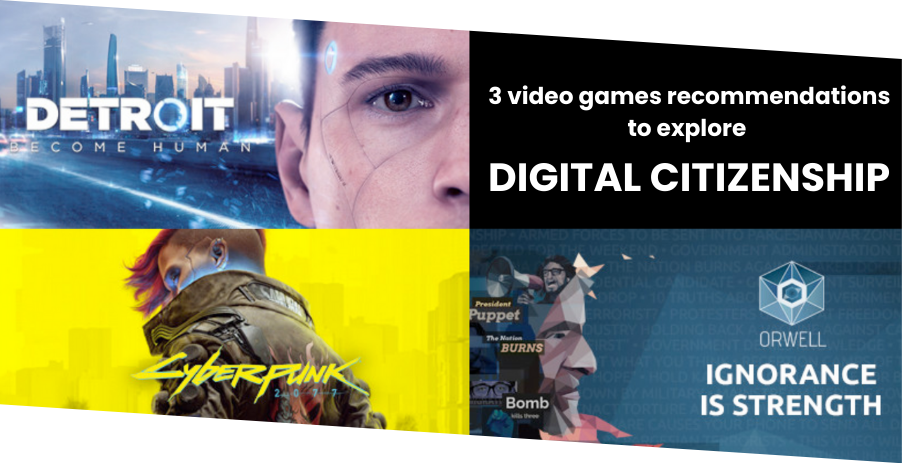
3 video games to explore digital citizenship
- Detroit: Become Human (Quantic Dream, 2018)
By 2038, androids have become indistinguishable from humans in appearance and intelligence, except that androids serve humans.
Detroit: Become Human explores the concept of digital citizenship through its narrative and the choices players make, which impact the story’s outcome. Set in a near-future Detroit where androids have become an integral part of society, the game delves into themes of identity, freedom, and what it means to be human. Players control three android characters—Kara, Markus, and Connor—each with their own unique experiences and perspectives on their existence and rights. The game’s branching narrative allows players to make decisions that affect not only the individual characters but also the broader societal implications of androids’ struggle for recognition and equality. This setup encourages players to consider the ethical and moral dimensions of digital existence and citizenship.
- Cyberpunk 2077 (CD Projekt Red, 2020)
The game invites us to discover the , controlled by a handful of technological mega-corporations.
By offering us three points of view at different hierarchical levels, the game converges towards a reflection on our relationship to our bodies, to technology, to surveillance, and to freedom in a corrupt society.
The game delves into the complexities of identity, privacy, and societal roles in a hyper-connected world dominated by advanced technology and corporate power. Players navigate a world where digital and physical realities blur, highlighting issues such as surveillance, data privacy, and the ethical implications of technological augmentation. The game’s storyline and character interactions often reflect the consequences of a society where digital presence and real-world actions are deeply intertwined, prompting players to consider the responsibilities and challenges of being a citizen in a digitally dominated world.
- Orwell: Ignorance is Strength (Osmotic Studios, 2018)
Based on the epnymous writer’s ideas, Orwell makes us work as an agent in a government that uses . The player’s goal will be to investigate the citizens of the country of Nation by searching their personal data in order to unravel a network of rebels plotting against the government.
The game explores the ethical and moral dilemmas associated with digital surveillance, data privacy, and the manipulation of information in a society where government oversight is pervasive. Players are given the power to intrude on personal communications, social media histories, and other digital footprints to resolve state crises, thereby highlighting the tension between national security and individual privacy. The narrative raises critical questions about the extent of government surveillance, the ethical implications of data collection, and the potential for misuse of information. By engaging with these themes, Orwell: Ignorance is Strength prompts players to reflect on their own digital footprint and the broader societal impact of surveillance technologies.
DigiCity: the video game
These are but a few of the games that we analysed to explore ways to create a video game on digital citizenship in our project. Our goal was to create a game to explore digital citizenship skills: through the design process, we decided to focus on misinformation, ethics, data protection, and cyberbullying.
Here is the pitch: You play as a student in the futuristic and hyperconnected world of DigiCity. As soon as you and your friends get a biotech implant to be able to communicate online 24/7, one of your friends’ social media account gets hijacked and she becomes the victim of a defamation campaign. Investigate, recognise fake and true information, and help your friend claim back her reputation!
Images source: Steam.com