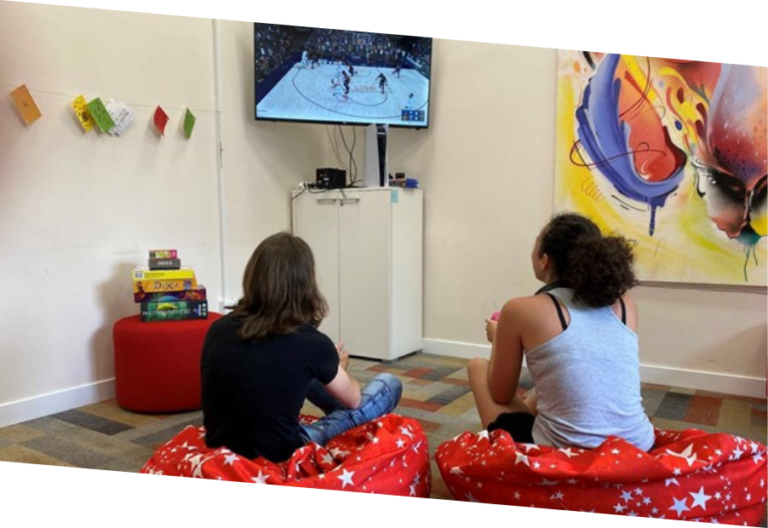

Article from Alessandro Soriani, Associate Professor of Special Education and Pedagogy (PAED-02/A) at the Department of Education Sciences of the University of Bologna.
Videogames are often framed as entertainment artefacts, yet their cultural and pedagogical relevance goes far beyond leisure. As highlighted in contemporary media education approaches, digital media (including videogames!) play a crucial role in shaping how individuals interpret reality, interact with others, and position themselves within society (Bogost, 2007).
Within this perspective, videogames can be understood as environments where players do not simply consume content, but actively engage with systems, values, and representations. This interactive dimension is what makes them particularly relevant for citizenship education: they allow players to experience social dynamics rather than only reflect on them abstractly (Soriani, 2020).
Citizenship, especially in its digital and global dimensions, requires competencies such as critical thinking, ethical awareness, participation, and understanding of complex social systems. Videogames, when approached critically, can offer meaningful opportunities to observe, simulate, and enact these dimensions (Soriani, 2024).
The following examples illustrate how specific games can foster engagement with citizenship-related issues through different modalities: observation, understanding, and interaction.
Observing citizenship: games as lenses on society
Some videogames may function as great observational tools, offering players a representation of social, political, or economic systems.
For example, Grand Theft Auto V (from Rockstar Games) appears as a controversial open-world crime game. However, a deeper reading reveals a sharp satire of contemporary society. Through its narrative, characters, and environmental storytelling, the game depicts elements such as: systemic inequality of the western world, consumerism and media manipulation, racial and social tensions and institutional fragility.
Players are not explicitly guided toward civic reflection, yet the game provides a dense representation of societal contradictions. This aligns with media education principles: understanding how media represent reality is a key step in developing critical citizenship.
In this sense, GTA V does not “teach” citizenship directly but invites players to question the society it portrays, thus it fosters critical thinking.
Understanding citizenship: games as systems of complexity
A second category includes games that help players understand complex societal issues by placing them within systemic simulations.
In this sense, “Green New Deal Simulator”, from Molleindustria, positions the player as a political decision-maker tasked with managing a national transition toward sustainability. Players must balance environmental policies, economic stability and social consensus in a very delicate interplay where each decision produces consequences, often unintended, forcing the player to navigate trade-offs between competing priorities.
This design directly supports the development of what OECD defines as global competence: the ability to understand global issues, evaluate multiple perspectives, and act responsibly.
Rather than offering simplified solutions, the game emphasises complexity, uncertainty, and responsibility: core dimensions of citizenship action.
In a similar vein, the Democracy games (from Positech Games) simulate governance systems where players must design policies and manage public opinion. The key learning dimension lies in understanding the interdependence between policies, the long-term vs short-term decision impacts and the tensions between ideological choices and practical outcomes… very powerful! Here citizenship is framed as a systemic practice rather than an individual act, highlighting the structural dimension of democratic participation.
Interacting with citizenship: games as spaces of action
The most powerful examples are those that allow players to interact directly with citizenship-related situations, often through narrative immersion and decision-making.
In “Papers, Please” (from Lucas Pope), the player acts as an immigration officer in a fictional authoritarian state. The gameplay revolves around bureaucratic procedures, but gradually introduces moral dilemmas: will you follow rules or help vulnerable individuals? Will you prioritize family survival or ethical responsibility? Will you stand by your government or support the resistance?
The game transforms abstract concepts such as migration, borders, and state power into lived experiences. It activates ethical reflection and empathy: essential components of digital citizenship, particularly within the domains of ethics and responsibility.
Educational implications: from consumption to critical engagement
The educational potential of videogames does not reside simply in their use within learning environments, but in the quality of the pedagogical mediation that accompanies them. Treating videogames as ready-made tools for learning risks reproducing the same limitations already observed in more traditional media: passive consumption, superficial engagement, and a lack of critical distance. What becomes necessary, instead, is a shift from a logic of use to a logic of interpretation and transformation.
In this sense, videogames can be integrated into educational practices through different but interconnected orientations. A critical perspective invites learners to interrogate how games represent reality, questioning the values, ideologies, and assumptions embedded in their narratives and mechanics. For instance, a game like “Grand Theft Auto V” can become a starting point for analysing how media construct social imaginaries, rather than simply a space for unreflective play. This approach aligns with broader media education goals, where understanding representation is a prerequisite for active citizenship.
At the same time, videogames can function as systems that make complexity tangible. Titles such as “Green New Deal Simulator”or “Democracy” allow players to experience the interconnectedness of political, economic, and social variables, highlighting the difficulty of decision-making in real-world contexts. Here, the pedagogical value lies not in transmitting predefined knowledge, but in fostering systemic thinking, the ability to anticipate consequences, and the recognition that citizenship often involves navigating tensions rather than resolving them definitively.
Finally, there is an experiential dimension that perhaps most clearly distinguishes videogames from other media. Through embodied interaction and decision-making, players are placed in situations that require ethical positioning. Games like “Papers, Please” or “This War of Mine” do not simply present moral dilemmas; they require players to act within them, confronting the consequences of their choices. This experiential engagement can support the development of empathy, ethical awareness, and a more situated understanding of rights and responsibilities – key components of citizenship in both digital and offline contexts.
However, these possibilities are not automatically activated by the mere presence of videogames in educational settings. Without structured opportunities for reflection, discussion, and re-elaboration, the risk is that gameplay remains confined to the level of experience, without generating deeper learning. The role of the educator, therefore, becomes crucial: to scaffold interpretation, to connect in-game experiences with broader societal issues, and to encourage learners to move from immersion to critical distance. In this way, videogames can contribute not only to engaging students, but to forming subjects capable of understanding, questioning, and actively participating in the complex realities they inhabit.
References
- Photo by Alena Darmel
- Bogost, I. (2007). Persuasive games: The expressive power of videogames. The MIT Press.
- Soriani, A. (2020). Videogame culture. A map for teachers and parents. Council of Europe Publishing.
- Soriani, A. (2024). Vite Extra. Educare ad una cultura del videogioco. Junior.